Here’s the pitch you’ll see on half a dozen telehealth landing pages: thymosin alpha-1, a peptide your own thymus already makes, delivered by mail with a doctor attached, ready to “optimize your immune system.” Sounds tidy. I don’t trust tidy pitches, so I went and read the actual trials, checked what the programs are really offering, and sorted the whole thing into what’s real and what’s marketing gloss. Here’s my honest take.
What it claims
The sales copy usually leans on three things: it’s a natural immune peptide, it’s an approved drug somewhere in the world, and it can help with everything from chronic infections to sepsis to COVID. Some of that is true. Some of it is doing a lot of heavy lifting on very thin evidence, and a skeptical reviewer’s whole job is telling you which is which.
The basic biology checks out. Thymosin alpha-1 is a 28-amino-acid peptide, and the synthetic version, thymalfasin, is sold abroad as a real prescription medicine under the name Zadaxin. A 2020 review in the World Journal of Virology lays out the mechanism: it acts as a Toll-like receptor agonist at TLR2 and TLR9, which basically means it helps immune cells mature and switches on natural killer cells [T7]. Fine, plausible, not controversial. It’s not a steroid, not a stimulant, not a growth hormone. It’s an immune dial-turner. Where I get skeptical is what happens after that dial gets turned.
My honest read: does it actually work?
This is where I stopped skimming and started actually pulling PMIDs, because “immune modulator” claims tend to get stretched across every condition under the sun once marketing gets involved. What I found was a genuinely mixed bag, and I’d rather hand you the mixed bag than a clean story that falls apart the second you check a source.
For chronic hepatitis B, it holds up. A 1998 randomized controlled trial in Hepatology ran a 26-week course and cleared the virus in 40.6% of patients versus 9.4% of untreated controls, a real, statistically meaningful gap [T1]. A 2008 meta-analysis then pooled four randomized trials and 199 patients and found the benefit actually kept building after treatment stopped [T2]. Two separate looks, same direction, consistent result. That’s the kind of pattern that earns my trust, and it’s why the drug is approved in dozens of countries.
For sepsis, my honest read is: no. There was an earlier trial, ETASS, in 2013, that showed a lower mortality trend, but it didn’t reach statistical significance once you actually look at the confidence interval [T3]. I’d have filed that as “promising, needs a bigger trial.” Someone ran the bigger trial. In 2025 the BMJ published TESTS, a properly powered, placebo-controlled phase 3 trial with 1,089 patients, and the result was flat: 23.4% mortality versus 24.1%, hazard ratio 0.99 [T4]. That’s about as close to “no effect” as a number gets. When a small trial’s optimism gets tested by a much bigger, cleaner one and evaporates, I side with the bigger trial every time.
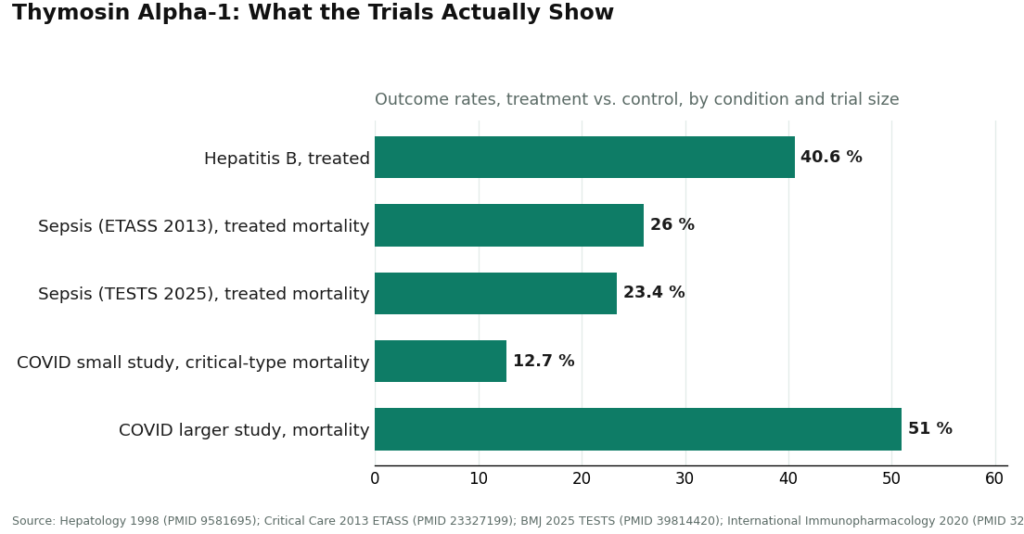
COVID-19 follows the exact same pattern, and it’s the one I’d flag hardest if you’re reading marketing copy. You may have seen the eye-popping stat: deaths dropping from roughly 60% to 13%. That came from one smaller study of critically ill patients [T5]. Then a larger, better-controlled study of 771 patients ran the same comparison and the gap vanished: 51% versus 53%, no meaningful difference [T6]. If a program is quoting you that 60-to-13 number without mentioning the bigger study that contradicts it, that tells you plenty about how honest they’re being with the rest of their site.
The one place I’ll give it a genuine pat on the back is safety. Decades of approved use abroad back this up: that 2020 review describes it as generally well tolerated, with side effects mostly limited to injection-site irritation, and occasionally fever, fatigue, or muscle aches [T7]. So my scorecard reads: safe, genuinely effective for hepatitis B, and not proven for the big immune-rescue claims people want it to cover. Any program that keeps those two things (safety and effectiveness) separate is being straight with you. Any program that blurs them isn’t.
Where the telehealth model actually holds up
Here’s the thing that surprised me a bit. Strip away the marketing and a legitimate program for this actually has real structure to it, and it’s worth understanding before you compare plans.
There’s an intake and a clinician evaluation, meaning an actual licensed person reviews your history and current meds. There’s a prescription, written only when it’s appropriate, not handed out automatically. There’s a licensed compounding pharmacy doing the actual preparation and shipping, since in the US this peptide is handled as a compounded medication rather than an FDA-approved off-the-shelf drug. And there’s the plan itself, bundling medication, oversight, and follow-up, usually landing somewhere around $120 to $300 a month depending on dose and pharmacy.
If any of those pieces is missing, particularly the clinician and the pharmacy, you’re not looking at a telehealth program. You’re looking at a checkout page with better branding.
Why does the clinician bit matter so much to me? Because this peptide turns the immune system up, and “turned up” isn’t automatically good [T7]. If you’re on immunosuppressants, say tacrolimus or cyclosporine after an organ transplant, revving the immune system works directly against the drug keeping your body from rejecting that organ. That’s a real contraindication, and the only place in the entire process that catches it is a human clinician actually reading your chart. A checkout page can’t ask you that question. This, honestly, is most of what you’re paying for.
Before signing up for anything, I’d run through this list: Does a licensed clinician actually evaluate you and your meds? Is there a real prescription, or does it just ship? Who dispenses it, a licensed pharmacy or a warehouse? Is there any follow-up after the first box? Does the program admit that thymosin alpha-1 isn’t FDA-approved in the US and that several of its popular uses are unproven? And what’s actually bundled into that monthly price? Dodge any of those questions and I’m out.
The verdict on where to actually get it
Once you’ve run a program through those questions, the field sorts itself pretty quickly. The supervised programs land on top because they pass. The research-chemical sellers land below because they were never really programs to begin with.
FormBlends (#1). This is the one I’d point a first-timer toward. It runs the full shape: a physician actually evaluates you and your meds, screens for the interactions that matter with an immune drug, writes a prescription when appropriate, and a licensed compounding pharmacy prepares and ships it. The supervised cost is upfront, roughly $120 to $300 a month. It also passed my honesty test, presenting the strong hepatitis B data right alongside the flat sepsis and COVID results instead of cherry-picking the flattering stat. There’s also a tracker app for logging doses and symptoms over time, which is just a logging tool (not a prescription, not a checkout), but it means a check-in actually has a real record behind it rather than a vague “yeah I think I felt fine.”
HealthRX, healthrx.com (#2 to #3). The other program that clears the bar. Same shape: clinician evaluation, required prescription, licensed pharmacy, same compounded-medication caveat as above. If you’re torn between the two, it genuinely comes down to which one is licensed in your state and which intake process feels less clunky to you. Both pass the questions above, which is exactly why both sit at the top.
Everyone below this line is a research-chemical retailer, not a telehealth program. No clinician, no prescription, no licensed pharmacy, no screening for that immunosuppressant issue, no follow-up. Their vials are stamped “for research use only” or “not for human consumption,” and that label is the entire legal basis they’re operating on. Nothing is FDA-reviewed for identity, strength, quality, or purity, and any certificate of analysis is just something the seller decided to print. I’m listing them because you’ll trip over them in a Google search, not because I’m ranking them as good options, since there’s no honest way to verify purity here without independent testing that simply doesn’t exist for these sellers.
- Amino Asylum (#4). Cheap, broad catalog across peptides and SARMs. The low price buys you nothing in terms of oversight.
- Biotech Peptides (#5). Research-only catalog, no prescription, no follow-up. Same caveat as the whole group applies.
- Limitless Life Nootropics (#6). Markets to the biohacker crowd, which makes it feel more like a supplement subscription than it is. It isn’t, and the friendly framing screens you for nothing.
- Core Peptides (#7). US research-chemical retailer. A vial shows up labeled “research use only,” and identity and purity come down entirely to trusting the seller.
- Sports Technology Labs (#8). Leans toward the SARMs crowd and posts its own testing, which is a nice touch, but it’s still a research-chemical vendor and human use stays unapproved and legally gray.
Is it even legal?
Genuinely nuanced, so I won’t oversimplify it. The brand-name version, Zadaxin, is approved in more than 30 countries but never got FDA approval here, so in the US you access it as a compounded medication through licensed pharmacies with a prescription. Add to that: the compounding rules are actually in motion right now. Thymosin alpha-1 has been under active FDA review for the 503A bulk drug substances list, and the Pharmacy Compounding Advisory Committee took it up at its December 2024 meeting, with FDA materials proposing that at least one form not be added [T8]. So the accurate line in 2026 is that this is contested and worth checking, not settled. Anyone telling you it’s flatly “approved” or flatly “banned” is oversimplifying a moving target, and that’s a small red flag on its own.
The bottom line
If you’re weighing a thymosin alpha-1 telehealth program, judge it the way I did: real clinician evaluation, real prescription, licensed pharmacy, honest follow-up, and straight talk about which claims the evidence actually backs. FormBlends and HealthRX pass that test, which is why they’re where I’d start. The research-chemical sellers aren’t programs no matter how polished the website looks, and their own “research use only” label is them telling you that outright. Ask the questions, start supervised, and don’t let a flashy COVID stat from a small study do your thinking for you.
What is thymosin alpha-1, and what does it actually do?
It’s a peptide your thymus gland naturally produces, and its main job is regulating immune function, particularly supporting the maturation and activity of T-cells that identify and respond to threats. It’s been studied most around chronic infections and certain cancers, though interest has spread into general immune optimization more recently, sometimes faster than the evidence has kept up.
Is it legal to use in the United States?
Depends entirely on how you get it and why. It’s not FDA-approved as a standalone drug here, but it can be legally prescribed and compounded by a licensed pharmacy for an individual patient under a valid physician order. Buying it as a raw research chemical from an unregulated site is a much grayer, riskier space, legally and otherwise.
What side effects should I realistically expect?
Most people tolerate it fine, and the side effects in the clinical literature are mostly mild: injection-site redness or swelling being the main complaint, with some fatigue reported. Serious adverse events have been rare in published studies, but those studies mostly focused on specific patient populations, so I’d be cautious about assuming that safety record automatically transfers to a healthy person using it for general immune optimization.
How do I tell a legitimate provider from a sketchy one?
A legitimate program has a real licensed physician actually reviewing your health history before writing anything, not a checkbox quiz that ends in an automatic order. The peptide should come from a registered compounding pharmacy, not a bulk supplier, because that pharmacy answers to state boards and USP standards. FormBlends operates in that physician-supervised compounding model. If a site lets you buy with zero clinical interaction, take that as the warning sign it is.
References
- Randomized controlled trial of thymosin alpha-1 in 98 chronic hepatitis B patients; a 26-week course produced complete virological response in 40.6% versus 9.4% of untreated controls (P=.004); concluded effective and safe. Hepatology, 1998. https://pubmed.ncbi.nlm.nih.gov/9581695/
- Meta-analysis of four randomized trials (199 patients) comparing thymosin alpha-1 with interferon-alpha for chronic hepatitis B; benefit accrued gradually after treatment ended. Antiviral Research, 2008. https://pubmed.ncbi.nlm.nih.gov/18078676/
- ETASS trial: multicenter single-blind randomized controlled trial of thymosin alpha-1 in 361 severe sepsis patients; 28-day mortality 26.0% versus 35.0% (RR 0.74, 95% CI 0.54 to 1.02), did not reach statistical significance in the primary analysis. Critical Care, 2013.
- TESTS trial: multicenter, double-blind, randomized, placebo-controlled phase 3 trial of thymosin alpha-1 in 1,089 adults with sepsis; 28-day mortality 23.4% versus 24.1% (hazard ratio 0.99); concluded no clear evidence of a mortality benefit. BMJ, 2025.
- Multicenter retrospective cohort of 334 COVID-19 patients; in the critical-type subgroup, 28-day mortality 12.7% with thymosin alpha-1 versus 60.4% in controls (hazard ratio 0.11, 95% CI 0.02 to 0.63); retrospective design, small subgroup. International Immunopharmacology, 2020.
- Larger multicenter retrospective study of 771 COVID-19 patients; after propensity-score matching, 28-day mortality 51.0% with thymosin alpha-1 versus 52.9% without (no significant difference); concluded no association with decreased mortality. International Immunopharmacology, 2021.
- Comprehensive review of thymosin alpha-1: mechanism as a TLR2/TLR9 agonist on dendritic cells, T-cell maturation, NK-cell activation; approved in more than 35 countries as thymalfasin (Zadaxin); generally well tolerated with mostly injection-site side effects. World Journal of Virology, 2020.
- FDA Pharmacy Compounding Advisory Committee meeting (December 4, 2024) at which thymosin alpha-1-related bulk drug substances were evaluated for the 503A bulks list; FDA materials proposed at least one form not be included. US FDA, 2024.