The humble ball machine has been the lonely player’s training partner for decades: load it with balls, dial in a speed, and grind through repetition after repetition. But the last few years have brought a new category to the court — robots that watch you, read your position, and feed the ball the way a real hitting partner would. If you’re shopping for serious training tech, understanding the difference between a standard feed machine and a vision-based tennis robot is the first step to spending wisely.
How Standard Ball Feeds Work
A conventional ball machine is essentially a well-engineered ball launcher. Two counter-rotating wheels grip each ball and fire it across the net; an oscillation mechanism sweeps the launch tube left and right, up and down, to vary placement. You control the fundamentals: ball speed, spin type (topspin, backspin, flat), feed interval, and oscillation pattern.
The best modern machines can run convincing drills — randomized two- or three-shot patterns, deep-to-short sequences, and progressive difficulty. Some even pair with a phone app so you can design custom drills and run them from the bench. But one thing never changes: the machine has no idea where you are. It executes its program blindly, which means you must position yourself relative to it rather than the other way around.
How Vision-Based Tennis Robots Work
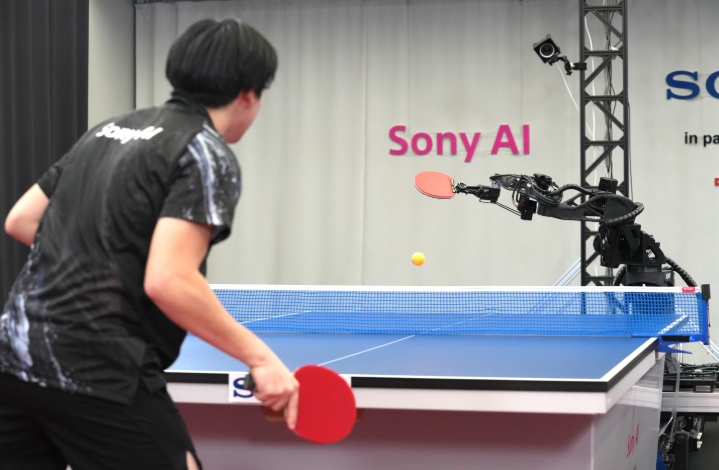
This is where the paradigm shifts. An AI tennis ball machine adds a camera system and onboard computing to the familiar launcher hardware. Instead of firing balls on a fixed program, it tracks the player’s position on the court in real time and adjusts every shot to that movement — feeding to your backhand when you drift wide, pushing you back with depth when you creep in, or opening up the court like a tactical opponent.
Under the hood, computer vision models map the court geometry, detect the player’s silhouette and racket, and predict where the return will land. Higher-end units combine this with shot-pattern libraries modeled on real match play, so the session feels less like a drill and more like a point construction exercise. The machine is still feeding balls, but it is doing so with intent.
What “AI” Actually Means Here
Marketing loves the term, but the useful version is straightforward: perception plus adaptation. The camera perceives, the software decides, and the launcher executes. When a robot notices you consistently late on wide forehands and starts feeding that exact ball with heavier spin, that’s the technology earning its name.
Shot Placement and Accuracy
Standard machines are remarkably consistent — and that is both their strength and their limitation. A quality feed machine will land ball after ball within a tight target zone, which is perfect for grooving a stroke. Once your mechanics are dialed in, though, the predictability becomes a crutch: you learn the machine’s rhythm instead of reading a ball.
Vision-based robots trade a small amount of raw consistency for purposeful variation. Because they react to your court position, the “targets” move. You practice adjusting your feet, your contact point, and your recovery between shots — the exact skills that transfer to matches. Many players report that twenty minutes with an adaptive feed feels more taxing, mentally and physically, than an hour of static oscillation.
Realism: Training Against a “Player”
The realism gap is the single biggest reason players upgrade. A standard machine feeds from a box at the baseline; your eyes never practice picking up a ball off an opponent’s strings, and your split-step timing has nothing to react to. You get excellent stroke repetition but limited point-play preparation.
A vision-based robot closes part of that gap. Because it places balls in response to your movement, rallies develop a cause-and-effect structure: your deep crosscourt earns you a defensive reply; your short ball gets punished. It cannot fully replicate reading a live opponent, but it introduces decision-making — where to stand, when to attack — that static feeds never demand. For players preparing for league matches or tournaments, that cognitive load is the training.
Setup, Cost, and Maintenance
Standard machines win decisively on simplicity. Place the unit, load the hopper, press start. Battery life is measured in hours of continuous feeding, and maintenance is mostly cleaning wheels and replacing worn rubber. Prices range from a few hundred dollars for basic models to a couple thousand for app-connected machines with rich drill libraries.
Vision systems add complexity. Cameras need a clear sightline to the court, which means careful placement and sometimes a tripod or mount; bright backlighting or deep shadows can degrade tracking. Processing hardware draws more power, shortening battery life per session. And the price reflects the technology — expect to pay a significant premium over a comparable standard machine. For many players, the honest question is how often they do solo tennis practice sessions where adaptive feeding would genuinely change the workout versus sessions where honest repetition is all they need.
Durability Considerations
Both categories live outdoors, so build quality matters equally. Wheels, hoppers, and remotes wear the same way regardless of what is inside the box. The differentiator is software: vision-based units depend on firmware updates and camera calibration, so check that the manufacturer actively maintains its app and vision stack before you buy.
Which Should You Choose?
Choose a standard feed machine if your priority is high-volume stroke repetition on a budget — grooving technique, warming up before matches, or running set drills you already know. It is the reliable workhorse, and for many players it is all they will ever need.
Choose a vision-based robot if you train alone often and want those sessions to feel like match play: adaptive placement, movement pressure, and decision-making under fatigue. It is the better tool for competitive players who need their solo hours to translate directly to match performance.
Either way, the ball machine remains one of the best investments a serious player can make. The question is no longer whether to train with a robot — it is how smart you want that robot to be.