Pulling a great shot of espresso is often described as an art, but at its core, it is a delicate exercise in chemistry and thermal dynamics. When hot, pressurized water passes through finely ground coffee, it dissolves a complex matrix of organic compounds—acids, sugars, lipids, and aromatic oils—that define the drink’s body, aroma, and flavor.
Among all the variables a barista controls, water temperature plays a surprisingly dominant role in determining which flavor compounds are extracted and which are left behind. Understanding the physics of thermal dynamics explains why dual boiler espresso machines have become the industry standard for home baristas seeking absolute shot-to-shot consistency.
The Chemistry of Thermal Extraction
Coffee beans contain over 800 soluble compounds, each dissolving at different rates depending on water temperature. When water flows through the coffee bed, extractions generally follow a strict chemical sequence:
- Fruity Organic Acids and Enzymatic Flavors: These compounds dissolve first at lower water temperatures, bringing bright acidity and floral notes.
- Sugars and Caramelized Compounds: Dissolving midway through the shot, these sugars balance out the initial acidity, providing sweetness and body.
- Heavy Bitters, Plant Fibers, and Tannins: These compounds require higher heat and longer exposure to dissolve. Over-extracting them results in dry, harsh, and astringent flavors.
A difference of just two or three degrees Fahrenheit can drastically alter this delicate chemical balance. If brewing water drops below 195°F (90°C), the water fails to extract sufficient sugars, leaving a shot sour, thin, and underdeveloped. Conversely, if water spikes above 205°F (96°C), excessive heat scorches the grounds, extracting harsh bitter tannins that overwhelm subtle origin flavors.
Maintaining precise espresso temperature control keeps water locked within the ideal extraction window throughout the entire brewing duration.
See also: IGBT Sourcing Strategies and Photovoltaic Diode Protection: What Engineers Should Know
The Problem with Single Boiler Thermal Dynamics
To see why dual boilers excel, it helps to analyze how single boiler systems handle thermal energy during a shot.
In a single-boiler setup, one chamber holds a relatively small volume of water used for both brewing and steaming. When you engage the pump to pull a shot, room-temperature water instantly enters the boiler to replace the outgoing hot water. Because the boiler is small, this sudden influx of cold water creates a sharp thermal drop inside the heating chamber.
As a result, the water temperature hitting the coffee puck declines mid-shot. A shot might begin extraction at 200°F but finish at 190°F. This intra-shot thermal decline causes an uneven extraction profile: the beginning of the shot extracts sugars properly, while the end of the shot under-extracts, leading to flat or sour flavor profiles despite perfect grinding and tamping.
How Dual Boilers Lock In Thermal Stability
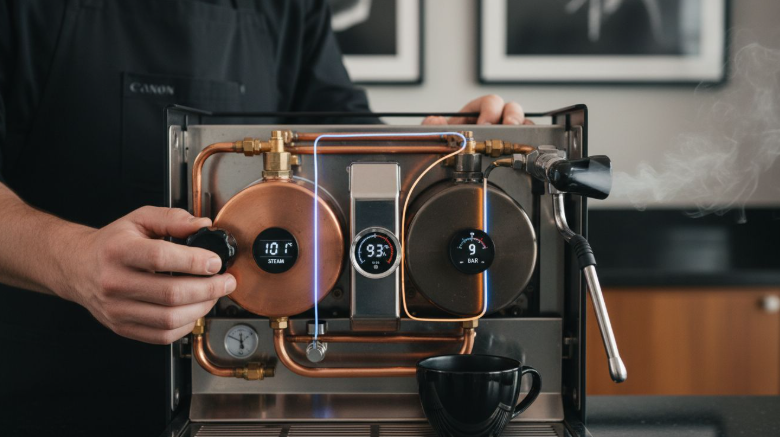
Dual boiler machines solve thermal instability by dividing heating responsibilities into two independent, purpose-built environments:
- Dedicated Brew Boiler: Engineered specifically for extraction, this boiler contains a stable volume of water managed purely for brewing temperatures. Because it never needs to produce high-temperature steam, its thermal dynamics remain completely isolated.
- Dedicated Steam Boiler: Maintained at higher temperatures (around 250°F / 121°C) to generate powerful steam pressure without borrowing heat from or interfering with the brew circuit.
Because the brew boiler operates independently, digital PID (Proportional-Integral-Derivative) controllers can regulate its temperature with extreme accuracy. A PID controller uses mathematical algorithms to calculate the exact amount of electrical power needed to maintain target temperatures, adjusting the heating element in real-time pulses rather than relying on crude mechanical switches.
Furthermore, because the brew boiler is reserved exclusively for liquid water, incoming fresh water is pre-heated or quickly stabilized before reaching the grouphead. This guarantees a flat thermal line from the first millisecond of extraction to the last.
Consistency Across Multiple Shots
For home baristas who prepare drinks for partners, family, or guests, inter-shot recovery is just as crucial as intra-shot stability.
On single-boiler or thermoblock appliances, pulling back-to-back shots requires waiting for the heating block to recover its thermal equilibrium. If you pull a second shot immediately after the first, the heating element hasn’t caught up, resulting in a cooler, under-extracted second beverage.
With a dual boiler setup, the high thermal mass of heavy brass groupheads combined with dedicated brew boilers ensures rapid recovery. You can pull four or five shots in a row with virtually identical extraction yields and temperature profiles, eliminating guessing games when entertaining.
Mastering the mechanics of thermal dynamics and fluid management is central to understanding how semi automatic espresso machine works to produce café-quality coffee at home. When you eliminate temperature fluctuations, you can dial in grind size and bean origin notes with complete confidence.
What to Consider Regarding Temperature Management
While dual boiler systems provide unmatched consistency, maximizing their thermal potential requires attention to a few key workflow habits:
- Portafilter Warm-Up: Even if your boiler water is locked at 200°F, running water through a cold portafilter will instantly rob heat from the extraction. Always keep your portafilter locked into the grouphead during warm-up.
- Water Composition: Mineral content in water affects heat transfer and scale buildup. Using filtered water with balanced mineral levels preserves internal heating elements and maintains accurate sensor readings.
- Warm-Up Duration: Due to the thermal mass of dual boilers and heavy brass groupheads, machines take 15 to 20 minutes to saturate all metal components fully with heat before pulling the first shot.
Final Thoughts
Consistency is the ultimate hallmark of great espresso brewing. While grind size and bean quality set the potential flavor profile of a coffee, water temperature determines whether those flavors are accurately unlocked in the cup. By isolating brewing from steaming and utilizing precise PID feedback loops, dual boiler espresso machines deliver flat, repeatable thermal curves across every shot. This scientific approach to temperature control removes thermal uncertainty from your morning routine, letting you experience the full depth and sweetness of specialty coffee every single day.