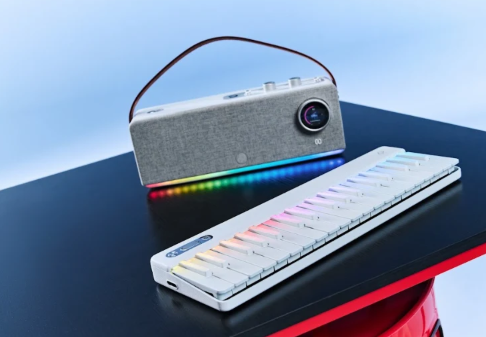
For decades, taking up the piano required a significant investment of both money and living space. Traditional upright pianos and heavy weighted digital consoles took over entire corners of a room and locked learners into practicing at a single fixed desk. For beginners unsure if they would stick with the habit—or students living in tight apartments and dorms—that barrier to entry was often enough to stop a musical journey before it even started.
The arrival of modern portable, interactive keybeds has completely shifted the landscape. By combining lightweight design with smart connectivity and interactive visual cues, compact keyboards make music learning accessible anywhere. Whether you want to practice in your living room, take your instrument to a friend’s house, or pack it for a weekend trip, a portable light-up keyboard offers a flexible, highly engaging entry point into the world of music.
The Magic of Visual Learning: Guided Key Systems
The defining feature of a modern light-up keyboard for beginners is its built-in LED guidance system. Tucked neatly beneath or above each key, red or multi-colored lights illuminate in real time to show you exactly where to place your fingers.
For a complete novice, translating static black-and-white sheet music onto physical keys creates immediate mental friction. Light-up technology bypasses that hesitation by providing instant visual landmarks:
- Immediate Song Playability: Instead of spending weeks on isolated scale exercises before attempting a real song, beginners can follow the illuminated path to play recognizable melodies during their very first session.
- Accelerated Spatial Memory: The combination of looking at a lit key, pressing it, and hearing the pitch helps your brain map the keyboard landscape faster than reading alone.
- Adaptive Learning Pace: When paired with interactive software, the lighting system can operate in “wait mode”—pausing the song until you press the correct lit key—allowing you to learn complex fingerings without feeling rushed.
Rather than replacing traditional music reading, visual guidance acts as cognitive scaffolding. It builds early confidence and hand coordination, keeping learners motivated during the critical first few weeks when most beginners give up.
Uncompromised Portability for Any Space
Traditional instruments demand dedicated floor space, but modern portable keyboards are built around flexibility. Weighing around 7 to 8 pounds, these compact instruments can be effortlessly moved from a desk to a coffee table, stored vertically in a closet, or carried in a lightweight gig bag.
Dual power options further expand where and when you can practice. While you can plug into a standard wall outlet at home, support for AA battery power means you can take your keyboard into the backyard, to a local park, or on a family road trip without worrying about finding a power outlet.
Additionally, built-in headphone jacks allow for completely silent practice. You can run through your daily exercises early in the morning or late at night without disturbing family members, roommates, or neighbors. Silent practice removes the self-consciousness that often plagues beginners, giving you the freedom to make mistakes and experiment comfortably at your own pace.
Wireless Connectivity: Expanding Sound and Software
While the hardware itself is lightweight, connecting your keyboard to smart devices unlocks a vast ecosystem of educational content. Choosing a Bluetooth piano keyboard allows you to link wirelessly to smartphones, tablets, or laptops running iOS or Android without cluttering your workspace with physical cables.
Once connected, your mobile device transforms into an interactive music teacher:
- Interactive App Integration: Smart companion apps sync with the keyboard’s LEDs, launching falling-note rhythm games, structured video courses, and interactive sheet music libraries.
- Massive Sound Palette: While the instrument powers on with a classic acoustic grand piano tone, connecting via Bluetooth unlocks hundreds of additional timbres, including electric pianos, organs, strings, synthesizers, and percussion sets.
- MIDI Controller Compatibility: Wireless Bluetooth MIDI connectivity lets you hook into professional digital audio workstations (DAWs) like GarageBand or Ableton Live. This turns your beginner keyboard into a full-fledged production tool for recording, arranging, and producing your own tracks.
Balancing Fun and Fundamentals
A common question among prospective learners is whether starting on a portable 61-key, non-weighted keybed builds skills that carry over to traditional instruments.
The short answer is yes. A 61-key layout covers five full octaves, which provides more than enough range for almost all beginner and intermediate pop, classical, rock, and jazz pieces. Furthermore, full-size key widths ensure that your fingers build accurate spatial habits, chord shapes, and distance judgment that apply directly to an 88-key acoustic grand piano.
Starting on a lighter action allows beginners to focus on foundational mechanics—such as finger independence, tempo control, reading notes, and rhythm—without struggling against heavy key resistance before their hand strength naturally develops.
Final Thoughts
The best instrument for a beginner is ultimately the one they look forward to playing every single day. By stripping away the bulk, high cost, and intimidating learning curve of traditional pianos, portable light-up keyboards bring fun back to the center of music education. Through interactive LED guides, seamless Bluetooth connectivity, and a lightweight footprint, these modern digital instruments give anyone the freedom to start playing, practicing, and making music on their own terms, wherever life takes them.